 MSU Irrigation Lab
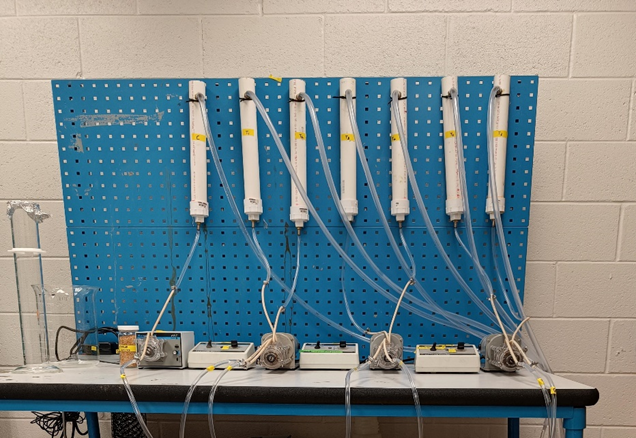
Phosphorus capture research evaluates media and structure designs that remove dissolved reactive phosphorus (DRP) from subsurface drainage and related agricultural water flows. The work connects laboratory adsorption studies with field-scale treatment concepts for water quality protection in systems that drain to sensitive waters such as the Western Lake Erie Basin (WLEB).
Dr. Soni Kumari leads this effort with support from the Michigan Department of Environment, Great Lakes, and Energy, in collaboration with Kieser & Associates, LLC.
Media performance and regeneration
Recent laboratory-scale column experiments investigated iron-activated alumina (Alcan) media for DRP removal from subsurface drainage water. The media showed high adsorption efficiency, with phosphate loadings up to about 8.3 mg/g and more than 90% recovery during the first desorption cycle using 0.1 M KOH. Subsequent adsorption–regeneration cycles confirmed reusability with a moderate decline in performance, supporting longer-term application.
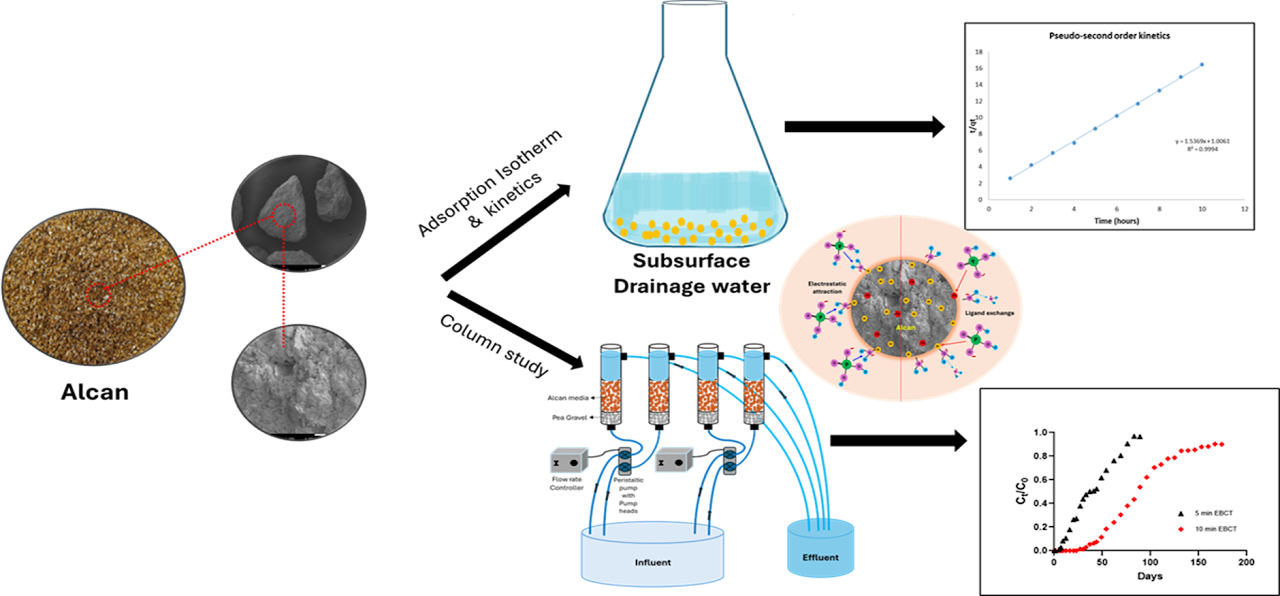
From lab columns to treatment structures
Broader goals include cost-effective media selection, operational design guidance for phosphorus removal structures in tile-drained landscapes, and pathways for nutrient recovery where feasible. Related work reviews biochar-based adsorption and recovery from waste streams, and operational design considerations for phosphorus absorption media (PAM).
Together, these studies aim at sustainable agricultural water treatment that reduces DRP loads while aligning with circular-economy approaches to nutrient reuse in agroecosystems.